
With such a varied programme, there was plenty to take away. From debates around the language we use to talk about climate action, to financing nature and making sustainability work commercially, several themes continued to emerge across very different discussions.
Here are some of the conversations that gave us the most food for thought.
Is “net zero” becoming a toxic term?
One of the most thought-provoking discussions we attended asked a fairly direct question: Has Net Zero Become Too Toxic to Deliver?
Featuring Pippa Heylings MP, Liberal Democrat MP for South Cambridgeshire, and Jack Abbott MP, Labour MP for Ipswich, the discussion explored the increasingly politicised nature of the term net zero and whether that is beginning to get in the way of the outcomes it represents.
Pippa acknowledged the challenges surrounding the phrase but argued that it could still be reclaimed. Part of that, she suggested, means doing a better job of communicating the progress that has already been made and reconnecting net zero with the wider challenge of climate change.
There was also an interesting discussion around the way net zero has increasingly become synonymous with energy, despite encompassing far more than how we generate electricity.
Agriculture, transport, industry, land use, nature and how we produce and consume resources all form part of the wider transition.
What made the conversation particularly interesting, however, was that it didn’t end when the session did.
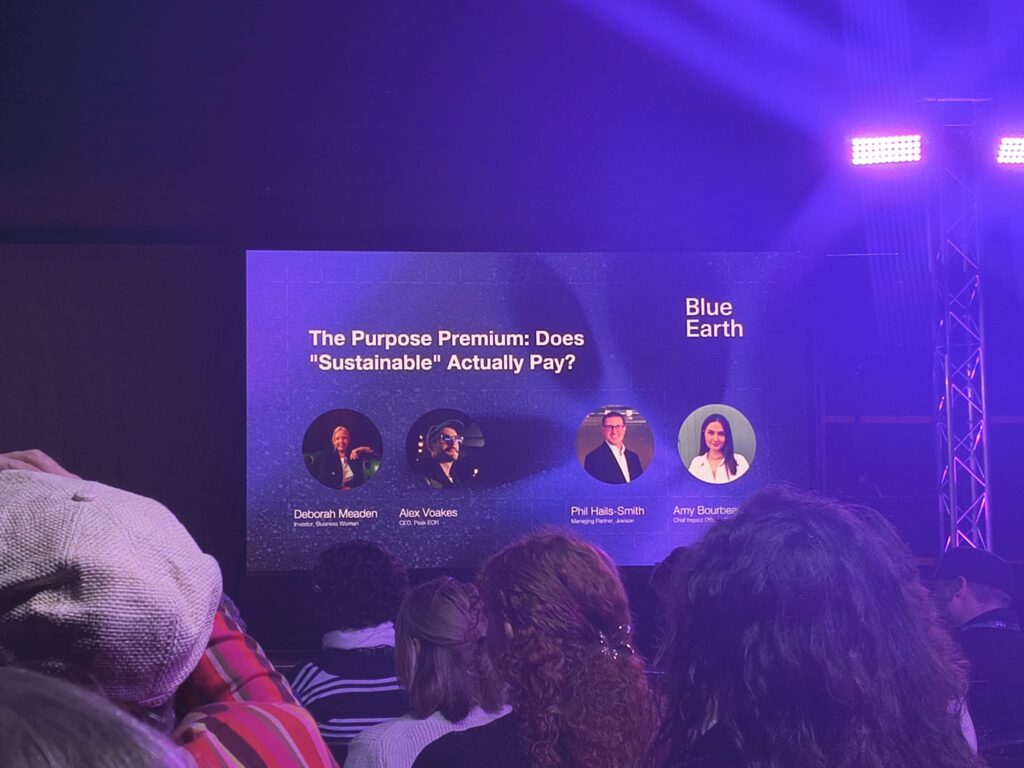
Later, during The Purpose Premium: Does “Sustainable” Actually Pay?, investor and businesswoman Deborah Meaden – who we’ll admit we were a little star-struck to see – raised the subject again.
This time, the view was considerably stronger. Deborah spoke about her dislike of the term net zero and questioned whether reducing such a complex conversation involving nature, energy and climate to two words is actually useful.
Hearing the issue emerge independently across two very different discussions highlighted a debate we perhaps hadn’t fully appreciated before attending the Summit.
For Carbogenics, it also hits close to home. Supporting the transition to net zero is at the heart of what we do, so the discussion wasn’t about questioning the importance of that goal. Instead, it made us think about how we communicate it.
Perhaps the outcome matters more than the terminology
One idea that stayed with us from the discussion was the importance of connecting climate ambitions to outcomes that people can actually see and experience.
Energy security matters. The price people and businesses pay for energy matters. Reducing exposure to volatile international fossil-fuel markets matters. Protecting and restoring the natural environment matters.
The terminology might change, but those challenges don’t.
During the net-zero discussion, Jack Abbott spoke about the importance of outcomes rather than becoming too caught up in the terminology itself. The conversation also touched on the relationship between domestic energy generation, energy security and the prices ultimately experienced by consumers and businesses.
It raised an interesting question for those of us working within sustainability:
Are we always communicating the outcome as effectively as we communicate the ambition?
Terms such as net zero, decarbonisation and sustainability are familiar within our industries, but they can become abstract when disconnected from the reasons behind them.
Perhaps there is an opportunity to spend less time asking people to connect with the terminology and more time demonstrating what the transition can actually deliver.
Nature needs investment too
The conversation around looking beyond energy flowed naturally into another session we attended: The 3% Problem: If Nature Works Why Are We Not Funding It?
The panel brought together Ed Gillespie, speaker, writer, poet and futurist; Gaia do Baptista, Advisor at Virunga Foundation; Freddie Ingleby, CEO of Caledonian Climate Partners; Will Foulkes, Co-Founder and CEO of Stabiliti; and Julia Steinberger, Professor of Societal Challenges of Climate Change at the University of Lausanne.
The discussion explored one of the fundamental challenges facing nature-based solutions: we increasingly understand the value of protecting and restoring natural systems, but getting sufficient capital to those projects remains difficult.
Freddie Ingleby discussed peatland restoration and the challenge of securing investment at the beginning of projects, despite the long-term environmental value that restoration can create.
Meanwhile, Gaia do Baptista brought another important dimension to the discussion: conservation cannot be separated from the communities living alongside the natural resources we want to protect. The conversation explored the importance of creating sustainable businesses and economic opportunities that allow value to remain within local communities rather than relying indefinitely on grant funding.
And Will Foulkes discussed the challenge of directing more private capital towards nature, including finding ways for businesses and consumers to contribute to projects while being able to understand and trace the impact they are supporting.
The approaches were different, but the underlying challenge was similar: protecting nature requires a model that can sustain itself financially as well as environmentally.
Sustainability still has to make business sense
That theme continued during The Purpose Premium: Does “Sustainable” Actually Pay?
Alongside the discussion around net zero, the session explored a question that is increasingly important for businesses: can purpose and commercial performance genuinely work together?
One of Deborah Meaden’s points was refreshingly straightforward. Investors may care about sustainability, but ultimately they also need to know whether an investment is going to generate a return.
For sustainable businesses, those two things don’t necessarily need to be in conflict.
The panel also discussed the growing scrutiny businesses face around environmental claims, reporting and measurement. Phil Hails-Smith, Managing Partner at Joelson, spoke about sustainability through the lens of business risk, including the increasing role of environmental considerations within due diligence.
One line particularly stayed with us:
“Don’t talk about sustainability, talk about business risks.”
It is an interesting way of reframing the conversation.
Climate impacts, resource availability, energy costs, changing regulation and supply-chain resilience aren’t simply environmental issues. Increasingly, they are business issues.
For companies developing sustainable technologies, demonstrating environmental impact is therefore only part of the story. Solutions also need to be commercially viable, resilient and capable of delivering measurable value.
Consistency matters
Another theme that emerged was the importance of consistency – particularly when businesses are being asked to make long-term investment decisions.
During The Purpose Premium, Deborah spoke about conversations she’d had with businesses through The Big Green Money Show and the recurring call for consistency from government.
Businesses can adapt to targets and requirements, but investment becomes considerably more difficult when the direction of travel repeatedly changes.
Many of the sustainability challenges being discussed at Blue Earth Summit stretch across decades, while political and business cycles are considerably shorter.
Creating the confidence required for businesses and investors to commit capital to long-term solutions therefore requires a level of certainty about where we’re heading – even if the precise route continues to evolve.
A wee special mention…
Not every takeaway had to be quite so serious.
With a packed programme and a lot of information to absorb, the regular guided breathing sessions led by Simon Lamb from Common Nature were a particularly welcome part of the Summit.
Taking a few minutes between discussions to stop, breathe, reset and realign before moving onto the next topic might seem like a small detail, but it made a noticeable difference across a busy day.
Sometimes the simplest ideas work surprisingly well!
Plenty of food for thought
If there was one overarching takeaway from Blue Earth Summit, it was perhaps that sustainability cannot be reduced to a single technology, industry or phrase.
It encompasses energy, nature, agriculture, investment, communities, business resilience and much more.
Whether net zero continues to be the terminology we use or the language evolves, the outcomes we’re working towards remain important.
For us at Carbogenics, supporting that transition means developing solutions that can deliver environmental benefits while also providing tangible value to the businesses using them.
And perhaps that’s one of the most useful reminders we brought home from Blue Earth Summit: the environmental and commercial conversations don’t need to exist separately.
For sustainable solutions to create lasting change, ultimately, they need to deliver both.


