
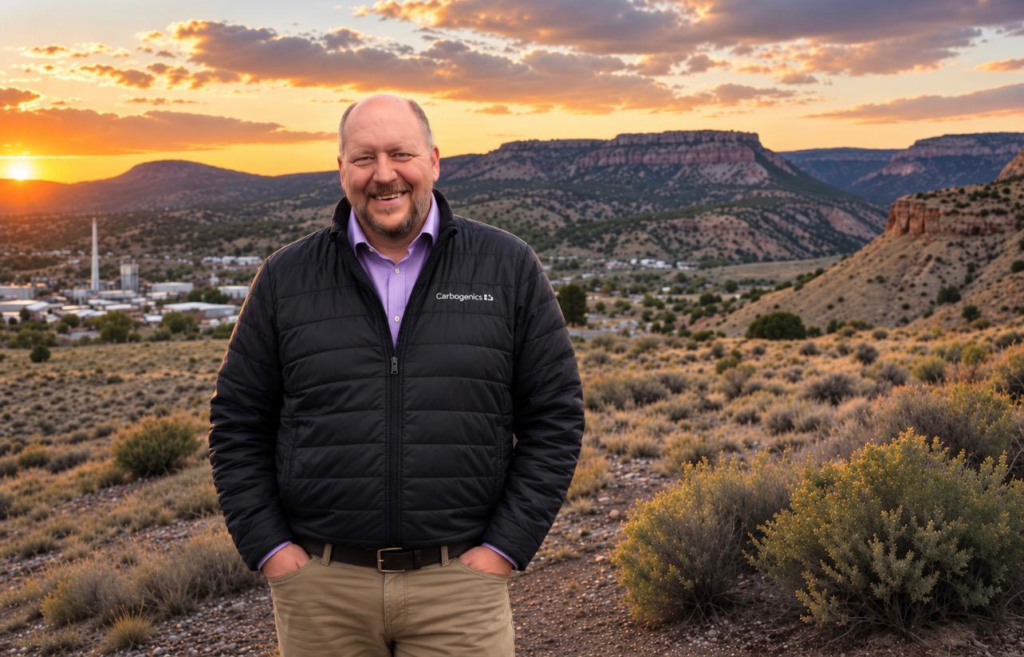
There’s been a lot happening at Carbogenics USA recently.
Our CEO, Ed Craig, returned to New Mexico this summer at a particularly exciting point in our US journey, as we move from plans on paper towards establishing production, growing our team and building the partnerships that will support Carbogenics’ long-term ambitions in North America.
But setting up in the US isn’t simply about replicating what we already do elsewhere.
From the beginning, our ambition has been to build locally, hire locally and use local resources – developing carbon solutions around the environmental and industrial challenges of the regions in which we operate.
So, naturally, Ed hit the road.
First stop: Las Cruces and NMSU
One of Ed’s first stops was Las Cruces, home of New Mexico State University (NMSU).
We’ve been speaking with experts at NMSU for some time, particularly around their work in agricultural biomass, forestry stewardship, biochar and anaerobic digestion.
This visit provided an opportunity to build on those conversations and explore another challenge with enormous significance for New Mexico and the wider South-West: water.
Across the region, prolonged drought, wildfire risk and increasing demand are placing considerable pressure on water resources.
At the same time, the Permian Basin generates more than one billion barrels of produced water each year – a wastewater stream containing high concentrations of salts alongside hydrocarbons and other contaminants that require treatment before the water can be safely reused.
For a water-stressed region, finding better ways to treat and reuse these enormous volumes could represent a significant opportunity.
And this is where several pieces of the Carbogenics story begin to come together.
From wildfire-damaged biomass to cleaner water
Northern New Mexico has another major environmental challenge: wildfire.
Forest management and wildfire mitigation can generate large quantities of low-value woody biomass. Rather than treating that material simply as waste, we’re exploring how it could become a local resource.
Our aim is to investigate how biomass from wildfire mitigation projects around areas such as Raton and Vermejo Estate could be transformed into engineered, high-surface-area biocarbons capable of contributing to water treatment.
In simple terms:
Local biomass → engineered carbon → cleaner water.
It creates the potential to address two regional challenges simultaneously: finding productive uses for low-value biomass while developing new materials that can contribute seriously to the treatment of contaminated water.
There is a wider resource-security opportunity too.
Activated carbon is already extensively used in water treatment and other environmental applications. Developing high-performance biocarbon alternatives from US biomass could help establish more resilient domestic supply chains, reduce dependence on imported materials and create more value – and potentially more jobs – within the region.
Alongside prospective partners including NMSU, Vermejo Estate and St. Cloud Mining Company, we’re now exploring how these different local resources and areas of expertise could work together.
Heading south to El Paso
Ed’s travels then continued south to The University of Texas at El Paso (UTEP).
Its location on the US-Mexico border makes UTEP particularly relevant to the challenges we’re interested in solving. Researchers there are working across areas including water reuse and desalination, brackish and produced water, environmental remediation, mining and critical minerals, and wider cross-border environmental issues.
Ed also had the opportunity to visit the Kay Bailey Hutchison Desalination Plant and other groundwater treatment facilities linked with El Paso Water.
Seeing these facilities first-hand matters.
We can develop innovative carbon materials in a laboratory, but understanding how water is treated at scale – the technologies already being used, the challenges operators encounter and where new materials might realistically fit – is essential if we’re going to develop solutions that have genuine commercial and environmental value.
That’s why these visits aren’t simply fact-finding missions. They’re part of building the relationships between research, industry, resources and real-world applications that will be needed to develop the next generation of Carbogenics products.
Thinking globally, acting locally
One theme has become increasingly clear throughout Ed’s trip: some of the biggest global environmental challenges require very local solutions.
Our ambition is to develop formal collaborations with institutions such as NMSU and UTEP, alongside businesses, utilities and other regional partners, to accelerate the development and testing of new carbon materials made from locally available resources.
New Mexico offers an unusual combination of challenges and opportunities: biomass requiring better management, significant pressure on water resources, industrial wastewater requiring treatment, strong research institutions and communities looking for sustainable economic opportunities.
For Carbogenics, that’s an environment where our carbon solutions platform has the potential to make a meaningful contribution.
And the technologies developed here don’t necessarily have to stay here.
A solution developed using New Mexican biomass for a New Mexican water challenge could ultimately have applications in other water-stressed regions around the world.
That’s thinking globally while acting locally in practice.
From conversations to Carbogenics USA
Perhaps the biggest change since Ed arrived is that this story is quickly becoming much more tangible.
We’re progressing plans to establish CreChar® production in North America, growing the Carbogenics USA team and developing relationships with potential customers, researchers, government representatives and industrial partners.
CreChar® will provide the initial foundation, bringing our established engineered biocarbon technology closer to North American anaerobic digestion operators.
But our ambitions in the US go much further.
The work taking place around water treatment, biomass, environmental remediation and carbon removal will help us explore entirely new products and applications for the wider Carbogenics carbon solutions platform.
The principle behind it all remains simple:
Build locally. Hire locally. Use local resources. Solve real problems.
Ed’s US adventure might have involved plenty of miles across New Mexico and Texas, but this is about much more than a road trip.
It’s about establishing the people, partnerships, resources and infrastructure that can turn Carbogenics USA from an ambition into a long-term business – and we’re only getting started.


