
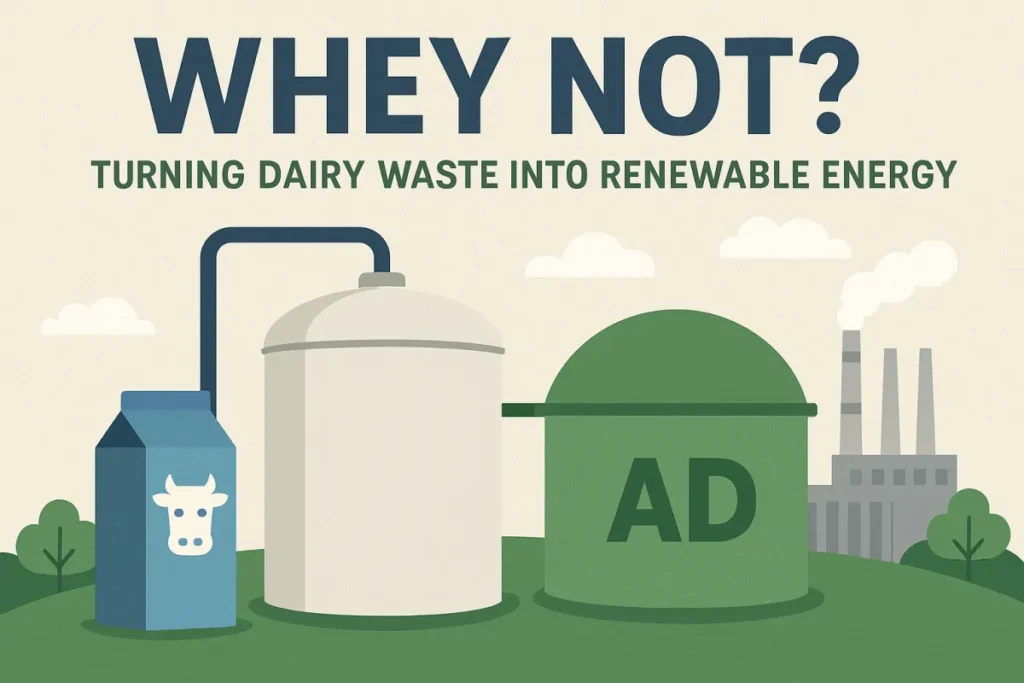
Dairy by-products don’t always get the spotlight – but maybe they should.
Every year, UK dairies produce thousands of tonnes of whey, a carbon-rich liquid left over from cheese and milk processing. Historically, much of this material has been costly to treat, difficult to dispose of, and far from glamorous. But things are changing. With rising feedstock prices, pressure to move away from energy crops and a renewed focus on circular agriculture, anaerobic digestion (AD) operators are increasingly looking to whey as a low-cost, abundant and underused opportunity – especially with the right tools to manage it.
But is whey really worth the hype – and more importantly, can it be made AD-friendly?
With CreChar®, the answer is yes.
Let’s break down why..
Why Whey Matters
As the UK drives toward Net Zero and circular agriculture, attention is shifting to waste-based feedstocks – especially those that deliver value without competing with food production. Whey fits perfectly into this category.
For dairy processors, disposal is a challenge. For AD operators, it’s a potential goldmine of easily digestible carbon.
Why now?
- High demand and rising costs for traditional feedstocks
- Reduced availability of crops due to climate pressures
- Increasing regulation pushing waste recovery and utilisation
- The need for higher biogas yields while keeping OPEX low
And here’s a fun fact:
Whey contains lactose — the same sugar bacteria ferment to make yoghurt. In a digester, that sugar becomes methane instead of milkshakes.
The Pros: Why Whey is Worth Considering
Even without treatment, whey is one of the most accessible and abundant dairy residues for AD.
✔ High Biogas Potential
Rich in lactose, proteins and organic acids, whey can help produce high methane yields compared to other wastes.
✔ Liquid and Easy to Handle
No shredding, milling or complex pre-processing — it can be pumped, blended and dosed directly into most systems.
✔ Abundant & Low-Cost
The dairy sector generates large volumes daily, often with limited disposal options. This creates affordable supply streams, sometimes even with gate-fee benefits.
✔ Ideal for Co-Digestion
Combined with other wastes such as slurry, crop residues or food waste, whey helps balance carbon availability and can increase overall throughput.
Fun Biogas Fact:
Whey’s methane potential is often 2–4× higher per unit of volatile solids than cattle slurry — but because slurry contains more solids, the wet weight advantage balances out. Still, whey is incredibly “energetic” per unit of VS
The Cons: Why Whey Can Be Difficult
Whey is not without challenges — and they can be significant.
⚠ Risk of Over-Acidification
Its high lactose content ferments rapidly, causing volatile fatty acid (VFA) spikes and pH drops that destabilise digestion.
⚠ Nutrient Imbalance
Whey is carbon-rich but low in buffering compounds and trace minerals, which can stress the microbial community.
⚠ Foaming & Mixing Problems
Rapid fermentation can cause foaming, stratification and scum layers – reducing gas capture and causing mechanical interruptions.
⚠ High BOD/COD Load
Whey wastewater is extremely oxygen-depleting, making disposal expensive and environmentally risky if unmanaged.
So why use whey at all?
In short – economics and availability.
Operators often turn to whey when:
- Crop feedstock becomes too costly
- Food waste contracts change or expire
- Plants want to increase renewable waste content
- Seasonal supply variability demands flexibility
- Co-digestion strategies need an easy carbon source
Whey is plentiful, cost-effective, and energy-rich – the challenge is making it behave in the digester.
And that’s where CreChar comes in.
CreChar®: Supporting Efficient Whey Digestion
CreChar is engineered to improve anaerobic digestion performance, especially when using fast-fermenting or difficult feedstocks..
How CreChar Helps
- Controls Acidity and Prevents Process “Crash”
CreChar supports buffering capacity, reducing VFA spikes and stabilising pH, meaning operators can feed whey more confidently without risking souring. - Boosts Methanogen Activity
Its porous structure creates micro-habitats for microbes, improving resilience and digestion efficiency – helping turn whey’s easy sugars into methane instead of acids. - Enhances Biogas Yield & Methane Quality
Trials show CreChar can increase gas output and methane concentration, improving energy return from each tonne of feedstock. - Reduces OPEX Through Smoother Operation
More stable digestion = fewer upsets, less downtime, and better handling of variable feedstock blends. - Supports Co-Digestion Strategies
Paired with slurry, food waste or manure, CreChar helps balance nutrients and maintain long-term microbial health – unlocking the full value of whey as a supplement feedstock.
Whey may be challenging – but with the right tools, it’s a valuable asset
What was once a costly by-product can become a consistent, renewable source of biomethane. With CreChar, AD plants can embrace low-cost feedstocks without compromising performance, stability or output.
More energy. More resilience. Lower cost. Less waste.
Exactly what modern AD demands.
Explore the impact in action
Read our case studies to see how CreChar supports challenging feedstocks and improves plant performance:
For more information on CreChar® or to discuss trials, contact:
Lidia Krzynowek – COO & Co-Founder
📩 lidia.krzynowek@carbogenics.com

