
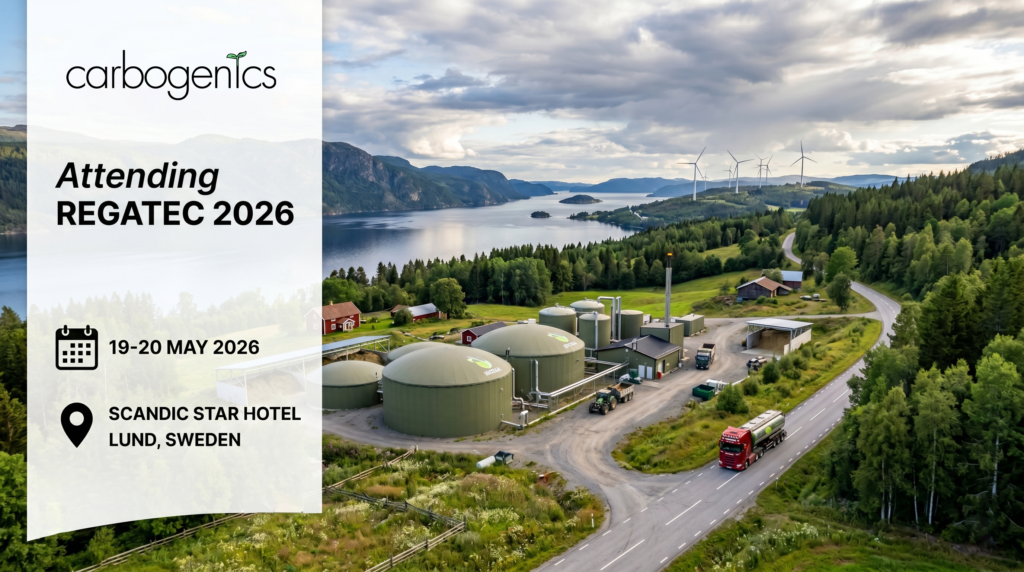
With Carbogenics attending REGATEC 2026 in May, our attention turns to Sweden and the wider Nordic region as a critical hub for innovation, collaboration, and commercial growth in the biogas and biomethane sectors.
REGATEC 2026: A Meeting Point for the Renewable Gas Industry
Taking place on 19-20 May 2026 in Lund, Sweden, REGATEC (International Conference on Renewable Energy Gas Technology) is one of the leading global events dedicated to renewable methane. Hosted at the Scandic Star Hotel, the conference brings together industry, academia, and policymakers to explore advancements in biomethane, bioSNG, and e-methane.
The event focuses on key areas such as:
- Anaerobic digestion (AD) and upgrading technologies
- Biomass gasification and power-to-gas
- Market development and policy frameworks
- Cross-sector integration of renewable methane
With international players including ENGIE, Gasum, and St1 Biokraft in attendance, REGATEC provides a high-value platform for partnerships and market insight.
For us at Carbogenics, participation offers direct exposure to one of the most advanced biomethane markets globally, supporting the drive for our CreChar® product – a biochar engineered specifically for Anaerobic Digestion (AD).
Sweden: A Mature and Expanding Biogas Market
Sweden represents one of the most developed biogas ecosystems in Europe, particularly in transport applications and circular waste systems.
- In 2022, Sweden operated 284 biogas plants, producing 2.279 TWh of biogas
- Of these, 71 upgrading plants generated 1.47 TWh of biomethane (source: uabio.org)
Biomethane plays a central role in Sweden’s transport decarbonisation strategy, fuelling buses, refuse trucks, and heavy-duty vehicles. Its integration into local energy systems – creates a highly circular and decentralised production model.
In addition, biogas accounted for 37.5% of total gas consumption in the western Swedish gas grid in 2022, highlighting strong penetration into existing infrastructure (source: nordionenergy.se).
This level of maturity presents a compelling opportunity: rather than building markets from scratch, we can scale within an already functioning and growing ecosystem.
What is often overlooked in mature biomethane markets like Sweden is that operational performance – not plant count – is now the primary constraint on further growth. Many AD operators are increasingly dealing with familiar bottlenecks: ammonia inhibition in nitrogen-rich feedstocks, foaming events under variable loading conditions, limits on organic loading rates (OLR), and declining gas yield stability in high-throughput systems.
As a result, attention is shifting from infrastructure expansion toward process optimisation strategies that improve biological stability and maintain consistent methane output. This is the environment in which technologies such as CreChar® – designed to support microbial stability and enhance digestion performance – are becoming increasingly relevant. Find out how HERE.
The Nordic Advantage: Why This Region Leads
The Nordics’ leadership in biomethane is not accidental – it is the result of several reinforcing factors:
Policy Certainty and Climate Ambition
Nordic countries consistently exceed EU climate targets, with long-term policy frameworks that de-risk investment. Subsidies, tax incentives, and blending mandates have enabled sustained growth.
- Abundant Feedstock
- Extensive agricultural activity and advanced waste management systems provide reliable feedstock streams, from manure to municipal organic waste.
- Technological Innovation
- The region is home to cutting-edge anaerobic digestion, upgrading, and liquefaction technologies, many of which are showcased at events like REGATEC.
- Infrastructure Readiness
- While gas grids vary in size, countries like Denmark have demonstrated how existing infrastructure can rapidly integrate biomethane at scale.
Denmark and Beyond: Scaling Biomethane to National Systems
Among the Nordics, Denmark is another fantastic example:
- Biomethane met ~25% of Denmark’s natural gas demand in 2023
- The country is targeting 100% green gas in the grid by 2030 (source:/www.afsenergy.nl)
This demonstrates the trajectory that other Nordic countries – and wider European markets – are aiming to replicate.
Meanwhile:
- Finland is expanding biomethane use in heavy transport and industry
- Norway is developing Bio-LNG solutions for maritime and freight sectors
Together, these markets form a regional cluster with shared regulatory alignment and growing cross-border trade potential.
Certification and Market Mechanisms: Enabling Scale
A defining feature of the Nordic biomethane market is its advanced certification and trading infrastructure.
- Guarantees of Origin (GOs)
- GOs certify each unit of biomethane injected into the grid, enabling transparent tracking and cross-border trade under EU frameworks.
- Proof of Sustainability (PoS)
- Nordic systems tightly link GOs with sustainability criteria, ensuring compliance with EU Renewable Energy Directive standards.
The Nordic Advantage vs the UK: Two Very Different Biomethane Trajectories
While the Nordics are often described as mature biomethane markets, the contrast with the UK highlights just how differently Europe’s renewable gas transition has unfolded.
While the UK hosts a comparable number of biogas installations to the entire Nordic region combined, the Nordics generate significantly higher output per plant, reflecting a more industrialised and system-integrated biomethane market.
A defining difference is policy structure.
Nordic countries have taken a long-term systems approach:
- Clear decarbonisation targets for gas grids (e.g. Denmark’s 100% green gas ambition by 2030)
- Strong alignment between waste policy, agriculture, and energy policy
- Stable investment frameworks that support large-scale plant development
The UK, by contrast, has relied more heavily on support schemes and incentives tied to specific production outputs, rather than fully embedding biomethane into gas grid decarbonisation strategy at national level. This has created investment cycles that are more sensitive to subsidy design and policy updates.
Feedstock strategy
The Nordics benefit from highly structured feedstock systems:
- Denmark: concentrated livestock production enables large manure-based plants
- Sweden: strong municipal wastewater integration and expanding agricultural digestion
- Finland and Norway: increasing focus on transport fuels and bio-LNG value chains
This creates predictable, industrial-scale feedstock supply chains.
The UK has strong feedstock potential (agricultural waste, food waste, landfill gas), but supply chains are more fragmented, with greater regional variation and less consolidation into large-scale hubs.
Infrastructure and end-use integration
Nordic countries have deliberately built biomethane into end-use sectors:
- Transport fleets (especially Sweden and Denmark)
- District heating systems
- Gas grid blending at high penetration levels
This creates guaranteed demand pull, not just supply push.
The UK has strong grid injection capability, but comparatively weaker direct end-use integration in transport and district heating systems, limiting the speed of systemic adoption.
A Strategic Opportunity for Carbogenics
For Carbogenics, the Nordic region – and Sweden in particular – offers a unique combination of:
- Established demand for biomethane
- Advanced infrastructure and policy support
- Strong innovation ecosystems
- Immediate routes to market via existing value chains
Attending REGATEC 2026 places Carbogenics at the centre of this ecosystem – connecting with key stakeholders, identifying partnership opportunities, and positioning for expansion in one of the most mature renewable gas markets globally.
Conclusion
Sweden and the wider Nordic region are not emerging markets – they are proven, scalable models of biomethane success. Their combination of policy ambition, technological leadership, and integrated market systems makes them a critical frontier for companies seeking to accelerate growth in renewable gas.

