Across the UK, the EU and north America, these materials represent both a waste challenge and a renewable energy opportunity. But while distillery waste can be a valuable feedstock, operators know that incorporating it into digestion systems is not always straightforward.
The Scale of Opportunity
Fun fact: The 1:10 ratio:
For every one liter of whisky that ends up in a bottle, roughly ten liters of liquid organic residue (pot ale+spent lees) are produced. In Scotland alone, this creates billions of liters of potential biogas feedstock annually.
For anaerobic digestion (AD) operators, that presents a clear opportunity; Distillery waste is locally available, often consistent in supply, and in many cases comes with attractive gate fee arrangements. In regions with high distillery density, it can represent a strategic feedstock shift – reducing reliance on purchased crops and lowering overall feedstock costs.
On paper, it makes commercial sense.
In practice, it’s more complicated.
Why Distillery Waste Can Be Challenging
Distillery residues are biologically rich – but they can also be demanding. Elevated sulphur levels can increase H₂S concentrations in biogas. Nitrogen content can fluctuate. Seasonal variations and batch differences can impact consistency. Managing these risks often requires tools that strengthen biological stability and buffer microbial systems when challenging feedstocks are introduced. One such solution is CreChar®
Fun Fact – Copper and the microbes:
Copper can accumulate in distillery effluents such as pot ale due to the use of copper stills, and copper ions can interact with the microbial communities in anaerobic digesters. While small amounts of copper are a micronutrient for certain microbes, higher concentrations can inhibit specific methanogenic pathways and affect performance.
For plants operating near CHP capacity, stability is non-negotiable. Gas engines need consistent quality and volume. A spike in H₂S or a dip in methane concentration doesn’t just affect performance metrics – it increases maintenance, chemical dosing and operational risk.
This creates a tension many operators recognise:
How do you incorporate cheaper, locally available distillery waste without destabilising your process?
Gas Quality Matters
One of the key considerations when introducing distillery waste is gas composition.
Fun Fact – The Methane Punch:
In AD systems treating whisky distillery wastes, a ton of spent grain (“draff”) can yield around ~80 m³ of methane (the energy-rich component of biogas) under operational conditions. This corresponds to roughly 800 kWh of usable energy – enough renewable energy to power a typical UK home’s electricity need for several days, according to standard household energy use estimates.
Higher H₂S concentrations increase corrosion risk and ferric usage. Fluctuating methane levels can reduce conversion efficiency in CHP engines. Lower-quality gas means more strain on equipment and potentially higher maintenance requirements.
For operators, this isn’t theoretical. It directly affects:
- Engine longevity
- Maintenance intervals
- Chemical additive costs
- Overall plant reliability
Maintaining consistent methane concentration and managing sulphur levels is critical if distillery waste is to become a long-term component of the feedstock recipe.
Managing Challenging Feedstocks
Successfully incorporating these materials requires a feedstock strategy that ensures biological stability and maintains gas quality.
This often involves:
- Maintaining Stable digestion under variable conditions
- Careful monitoring of gas quality
- Confidence in maintaining output
When that stability is achieved, the benefits are significant. Operators can:
- Reduce reliance on higher-cost crops
- Capture gate fee revenue
- Lower overall feedstock costs
- Maintain consistent gas production
In regions where distillery waste is abundant, the plants that manage it effectively are not just solving a disposal problem – they are strengthening their commercial position.
Explore the impact in action
Read our case studies to see how CreChar supports challenging feedstocks (such as distillery waste in Case D) and improves plant performance:
Case Study D: Turning spirits into power: How distillery wastes boost methane and yield
The biogas plant utilised various types of distillery waste, supplemented by other agricultural residues. During the six-month CreChar dosing period, reliance on costly feedstocks was reduced, operational efficiency improved, biomethane yield was maintained, and the average methane content increased by 2–3%.
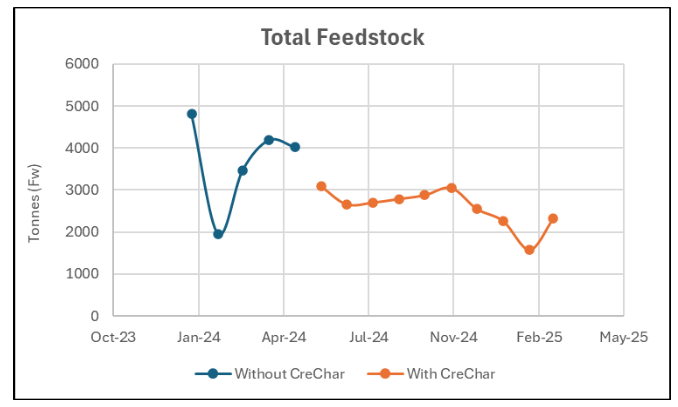
Reduction in the total feedstock from peaks near 4,000–5,000 tonnes down to a range of 1,500–3,000 tonnes.
The plant maintained gas output while cutting feed requirements by roughly half.
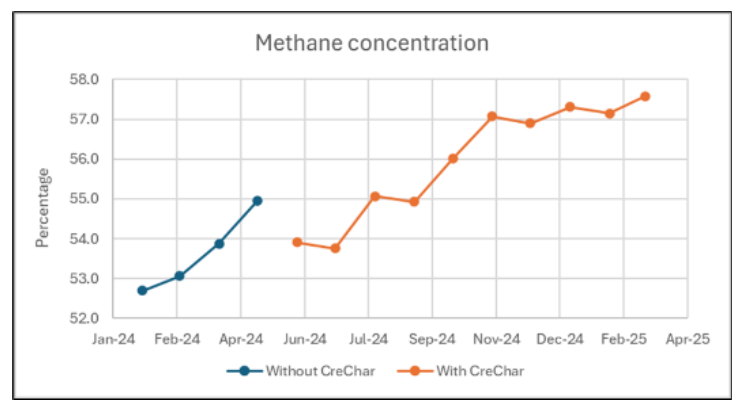
Consistent climb in methane concentration after the addition of CreChar.
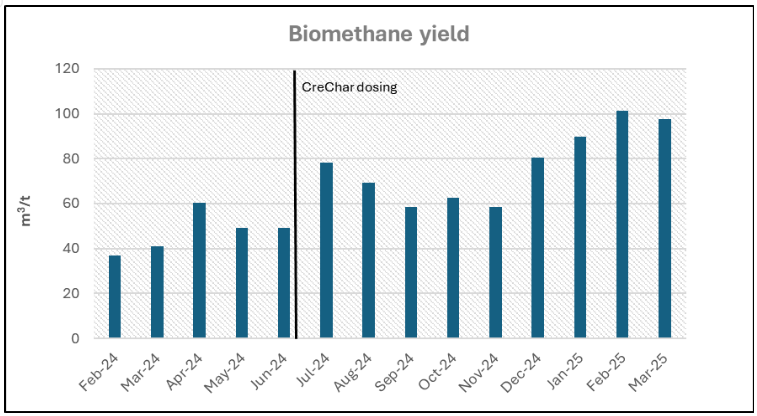
Upward trend in biomethane yield after the addition of CreCrar.
Yields started between 40-60 m3/t in early 2024 and increased to over 80-100 m3/t by March 2025. This indicates that CreChar improved the biological efficiency of the digestion process.
The Bottom Line
Fun Fact – From Whisky to Soil
The digestate remaining after anaerobic digestion still contains nitrogen and phosphorus originally present in the feedstock.
When responsibly applied to land, this nutrient-rich material can act as a valuable soil amendment, helping close the agricultural nutrient loop.
In effect, the waste from last year’s whisky can help grow the grain for the next batch.
Is Your Digester Ready for Distillery Waste?
Distillery waste represents both risk and opportunity.
Handled poorly, it can introduce instability and operational challenges.
Handled well, it can:
- lower feedstock costs
- improve local circularity
- strengthen plant economics
For many AD operators, the key question is no longer whether distillery waste is available.
It is whether their digestion process is ready to manage it effectively.
For more information on CreChar® or to discuss trials, contact:
Lidia Krzynowek – COO & Co-Founder
📩 lidia.krzynowek@carbogenics.com